Accessibility strategy

Inclusive Quin

Healthcare

Accessibility

Workshops

After image depicting the new Knowledge Hub as a resources page next to the Circle Economy Website.

Context

Quin is a Dutch digital health platform that guides patients through a symptom-check before their GP consultation.

Context

Quin is a Dutch digital health platform that guides patients through a symptom-check before their GP consultation.

Challenge

Quin had accessibility ambitions, but no shared framework for acting on them. The team wanted internal alignment and a company-wide strategy to improve their product.

Challenge

Quin had accessibility ambitions, but no shared framework for acting on them. The team wanted internal alignment and a company-wide strategy to improve their product.

Solution & Impact

Through a three-part workshop series we produced a shared accessibility strategy, a prioritized improvement backlog, and a final presentation of learnings and recommendations for internal use.

Role

Workshop designer and facilltator

Duration

1 month, 2021

Company

Quin

Team members

Ingrid Pfrommer, project lead, OnderAnderen

Dean Birkett, accessibility presenter

Skills

Workshop creation

Facilitation

Presentation design

Tools

Miro

Powerpoint

Process

1

Preparation

My colleague at OnderAnderen led the project and developed the content and agenda. I contributed to brainstorming the structure and exercises, then took ownership of building the Miro environment — setting up the boards, organizing the exercise flows, and preparing all digital materials the team would work with on the day.

1

Preparation

My colleague at OnderAnderen led the project and developed the content and agenda. I contributed to brainstorming the structure and exercises, then took ownership of building the Miro environment — setting up the boards, organizing the exercise flows, and preparing all digital materials the team would work with on the day.

2

Awareness presentation

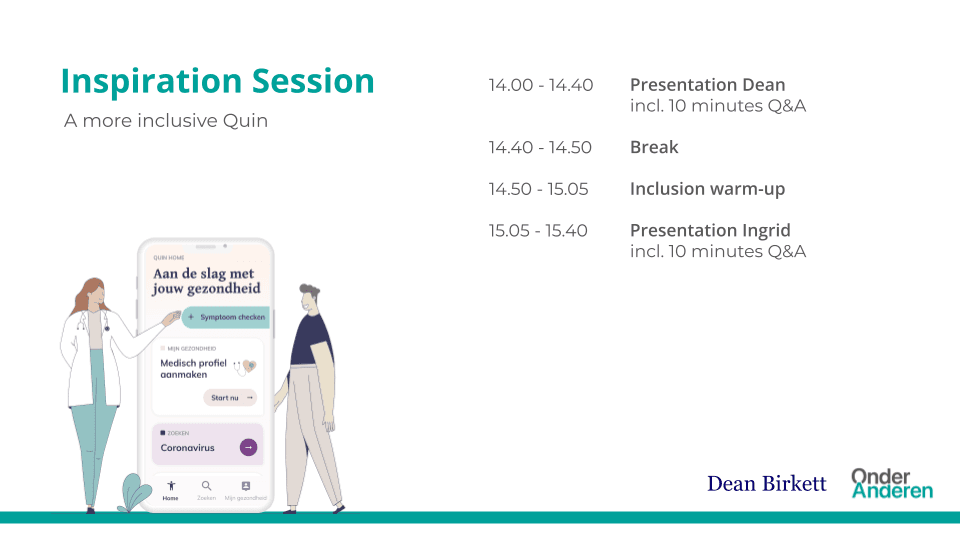
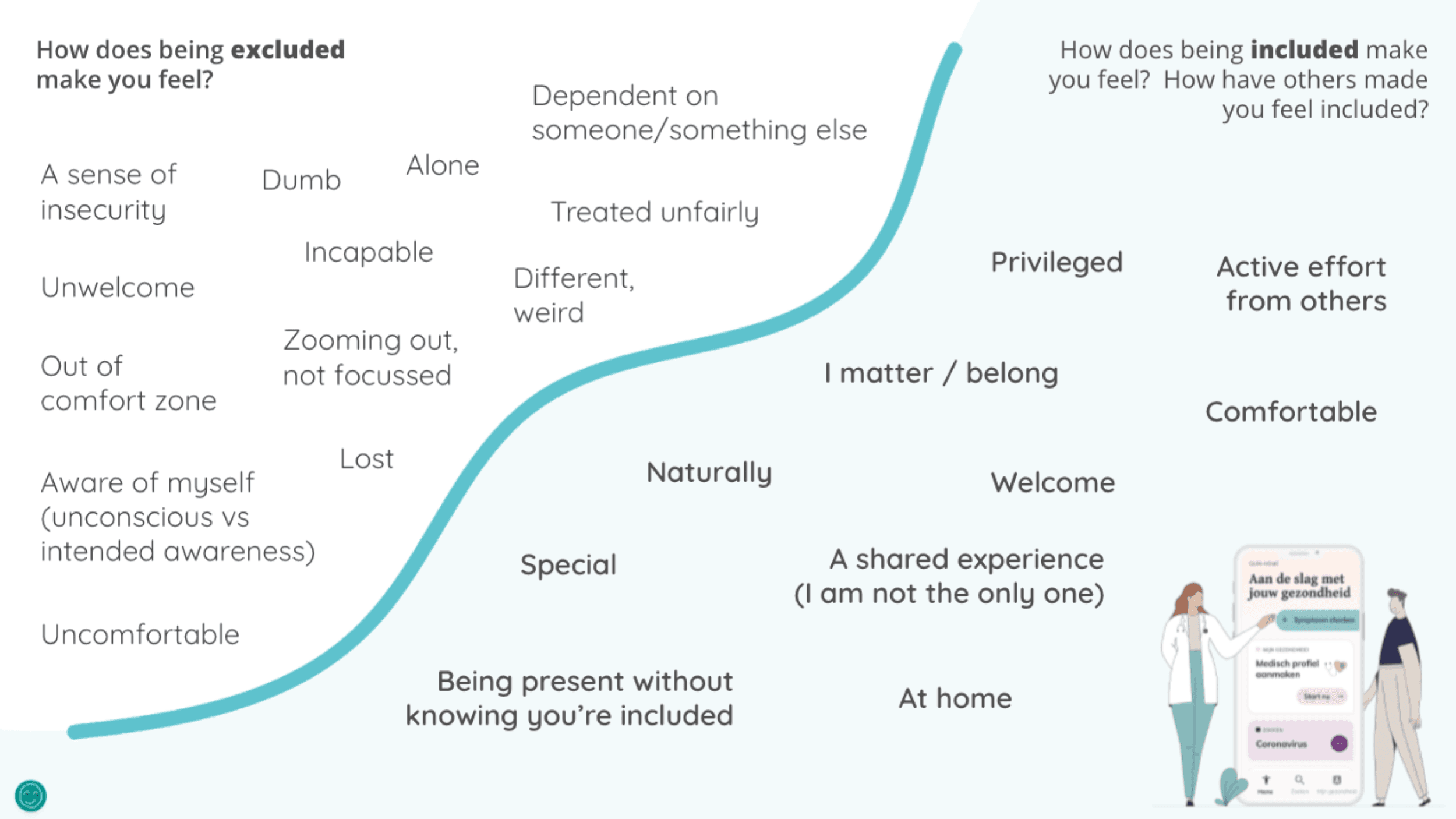
Before the workshop, an interactive 2-hour presentation was held for Quin's POs, designers, and copywriters — led by Ingrid and accessibility consultant Dean Birkett. I served as moderator. The session introduced key accessibility terminology, real-world examples relevant to Quin's product, and the practical implications of inclusive design, with space for questions throughout.
3

Workshop

The workshop moved through three structured sections.

The first built a shared picture of Quin's patient diversity, working through accessibility persona sets, then applying them directly to Quin's symptom-check and appointment flows. The Wheel of Diversity widened the frame beyond disability, surfacing how language, family structure, and religious context also shape patient experience.

The second section moved from empathy to analysis: mapping six barrier categories (visual, hearing, motor, speech, cognitive, social exclusion) against WCAG guidelines, the most common accessibility failures, Nielsen Norman's ten usability heuristics, and plain language principles.

The third section focused on prioritization: the team generated improvement ideas through guided ideation, then plotted them on an impact/effort matrix, yielding four action tracks — design, research, development, and quick fixes.

I helped facilitate the exercises throughout and guided the matrix activity to ensure ideas were placed with enough nuance to be genuinely actionable.

One concrete idea emerged immediately: auto-saving form data in the background so patients wouldn't lose progress if connectivity dropped.

3

Workshop

The workshop moved through three structured sections.

The first built a shared picture of Quin's patient diversity, working through accessibility persona sets, then applying them directly to Quin's symptom-check and appointment flows. The Wheel of Diversity widened the frame beyond disability, surfacing how language, family structure, and religious context also shape patient experience.

The second section moved from empathy to analysis: mapping six barrier categories (visual, hearing, motor, speech, cognitive, social exclusion) against WCAG guidelines, the most common accessibility failures, Nielsen Norman's ten usability heuristics, and plain language principles.

The third section focused on prioritization: the team generated improvement ideas through guided ideation, then plotted them on an impact/effort matrix, yielding four action tracks — design, research, development, and quick fixes.

I helped facilitate the exercises throughout and guided the matrix activity to ensure ideas were placed with enough nuance to be genuinely actionable.

One concrete idea emerged immediately: auto-saving form data in the background so patients wouldn't lose progress if connectivity dropped.

4

Report delivery

I synthesized the workshop outputs into the final client deliverable: a branded presentation in Quin's visual language, structured around the workshop's three questions and built to be used independently in internal meetings. Together with the written report, it gave the team a lasting artifact they could reference and share without needing to return to the Miro board.

4

Report delivery

I synthesized the workshop outputs into the final client deliverable: a branded presentation in Quin's visual language, structured around the workshop's three questions and built to be used independently in internal meetings. Together with the written report, it gave the team a lasting artifact they could reference and share without needing to return to the Miro board.

Outcomes

Shared vocabulary

The team left with common language around barriers and who experiences them, grounded in WCAG, the Microsoft Persona Spectrum, and hands-on exercises.

Prioritized backlog

Ideas were sorted by next step and by impact versus effort, giving the product team a clear path forward rather than an overwhelming wishlist.

Strategic recommendations

Five organizational priorities named:

  • Appoint an inclusivity ambassador at management level

  • Involve diverse patients in ongoing testing

  • Embed inclusive design tools into day-to-day process

  • Begin WCAG certification with the five most common failures

  • Implement recommended quick fixes immediately.

A durable resource

The Miro board stayed live after the project closed. The presentation was formatted to function independently inside the organization.

Were the challenges met?

"How might we build company-wide understanding of accessibility, and give Quin a practical, prioritized framework for acting on it?"

Who is experiencing barriers?

Through persona exercises and the Wheel of Diversity, the team built a shared, nuanced picture of Quin's patient base, moving beyond their default user assumptions to consider the full spectrum of people who contact their GP.

What barriers exist, and how can they be solved?

The workshop mapped the app's gaps across six barrier categories and grounded them in WCAG guidelines, usability heuristics, and real design examples. The team left with concrete reference points they could apply to their own work going forward.

How to turn insight into action?

The impact/effort matrix translated a broad set of ideas into a prioritized action plan across four tracks (design, research, development, and quick fixes) alongside five organizational recommendations for embedding inclusivity long-term.

Reflections

My role: I joined as a freelancer supporting OnderAnderen's lead consultant, and helped shape how the work was experienced in the room and how its results were communicated. My contribution included brainstorming the workshop structure, building and running the Miro environment, moderating the awareness session, co-facilitating the exercises, and leading the final presentation and report.

What went well

Building the Miro board in advance meant participants moved directly into exercises without friction. The impact/effort matrix produced genuinely useful prioritization — concrete enough to hand off to a development team.

What could be better

The personas were borrowed from an existing set rather than co-created with Quin patients. First-hand input from diverse users would have made the prioritization sharper. The final recommendations flagged this themselves — involving diverse patients in testing was listed as the first priority, and it would have been stronger to start that earlier.

What could be better

The personas were borrowed from an existing set rather than co-created with Quin patients. First-hand input from diverse users would have made the prioritization sharper. The final recommendations flagged this themselves — involving diverse patients in testing was listed as the first priority, and it would have been stronger to start that earlier.